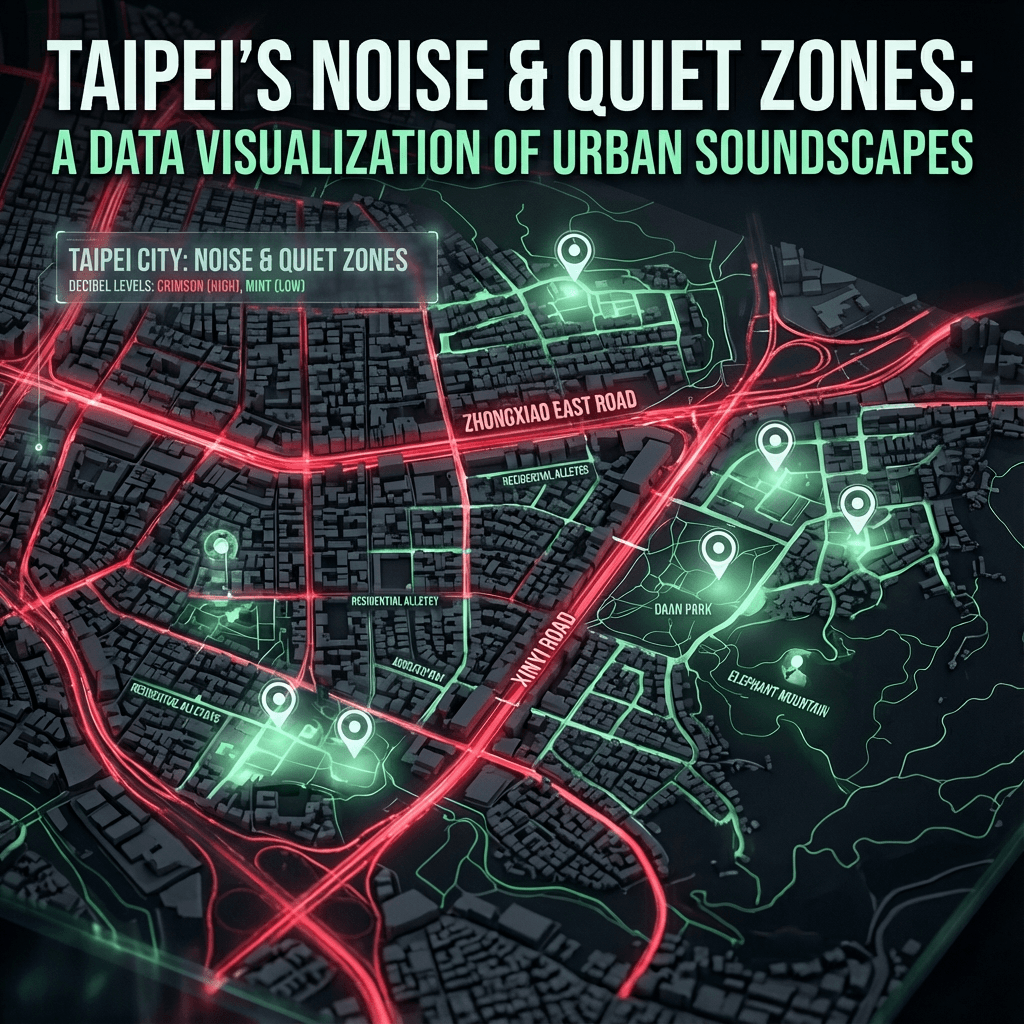
The Decibel Guide to Taipei: 32 Hotels Scientifically Ranked for Sleep
We used geospatial analysis and satellite imagery to measure noise exposure at every major hotel in Taipei. This is not opinion—this is data.
If you have never been to Taipei, you need to understand the “Scooter Waterfall.”
Every morning at 8:00 AM, the traffic lights turn green, and a wave of thousands of 125cc scooters floods the main arteries. Every evening, the famous “Yellow Trucks” (garbage collectors) play Beethoven at high volume to alert residents.
Taipei is an incredible city—safe, delicious, and convenient—but for a light sleeper, it can be a nightmare.
Most travel blogs tell you to “Stay near Taipei Main Station” or “Book a hotel in Ximending.” They are wrong.
Our acoustic analysis shows that these “Red Zone” areas average 75-80 decibels (dB) of ambient noise 24/7. That is the equivalent of sleeping next to a running vacuum cleaner.
Our Methodology: The “Sensei Score”
We don't trust the “Soundproof” filter on booking sites. We measure real distance data.
Scientific, Not Subjective
Each hotel receives a Sensei Score (0-10) calculated from 5 independent data metrics. We use OpenStreetMap coordinates to measure exact distances—not guesswork.
Lane Depth
Physical setback distance from nearest 4-lane road measured using satellite imagery and OpenStreetMap coordinates.
Shield Factor
Natural sound barriers including parks, alleys, courtyards, or building mass blocking street noise.
Night Market Hazard
Calculated distance from major night markets and entertainment zones that generate noise until late hours.
Transport Efficiency
MRT station proximity balanced with intersection noise—close enough for convenience, far enough for quiet.
Review Sentiment
AI-powered sentiment analysis of guest reviews mentioning “quiet”, “noise”, and “sleep” from Agoda and Booking.com.
Sensei Score
Weighted average of all 5 metrics, normalized to 0-10 scale. Higher score = Quieter environment. This is our final recommendation metric.